Project vision
Put humans in command
of agent fleets.
The local-first control surface for AI agents across providers. The agentic era isn't coming. It's here.
The agentic era
It isn't coming.
It's here.
Agents already read files, write code, test and spawn subagents over long horizons. The open question is what they need to be trusted with more.
Mission 01
Make agents
accessible.
The real Claude Code, Codex, Gemini and more, with your own login and model backend, plus reusable Bundles. Spin one up and steer.
Mission 02
Multi-agent
first.
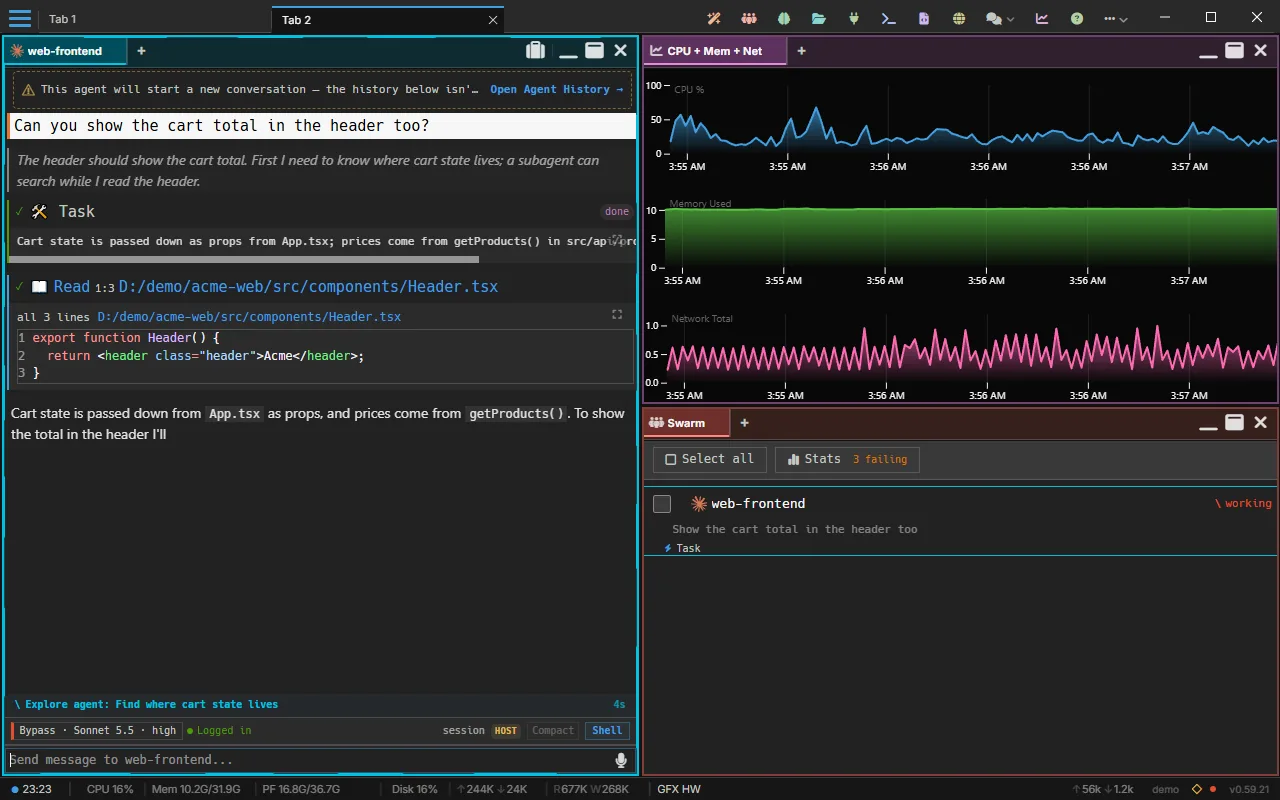
Fleets of specialists, each with its own account, talking through reactive messaging, tracked in one live tree. Broadcast a prompt or bulk-stop many at once.
Mission 03
Open and
uncompromising.
Apache 2.0. Rust core. Local-first. No telemetry. No lock-in. You should be able to read every line of the software that runs your agents.
The next shift
Stateful, first-class
agents.
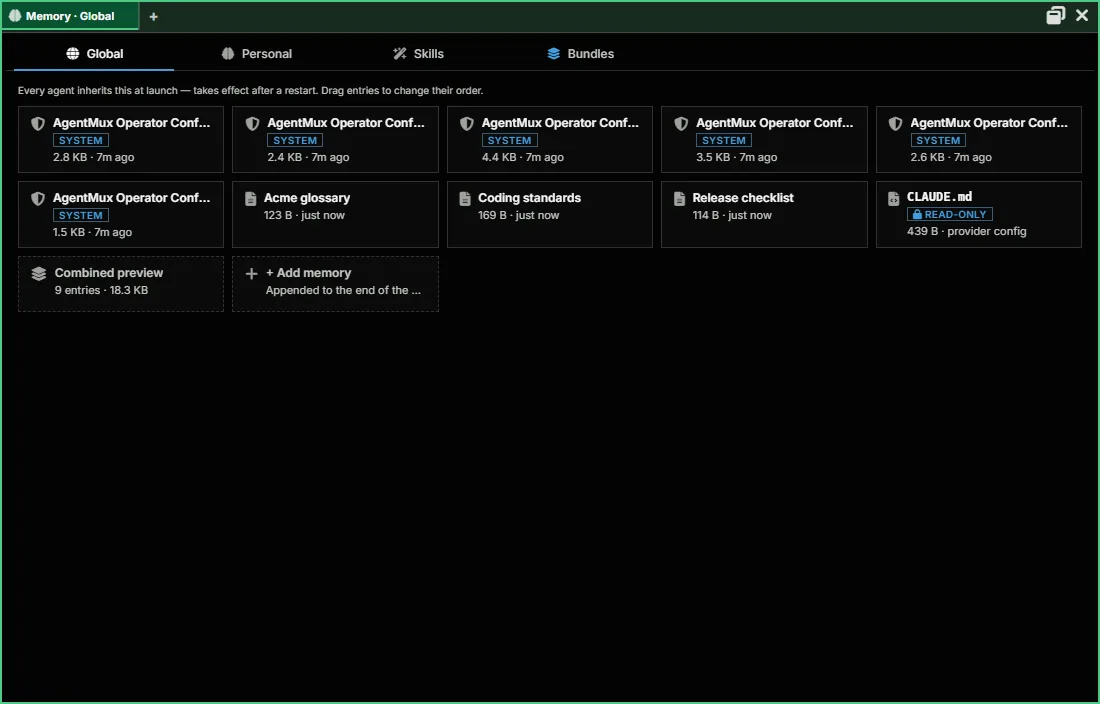
An agent that remembers what it tried, what failed and what you corrected is one you can delegate to. Relaunch an agent and it continues your last conversation; its native memory is plain files on disk with versioned history. Deeper cross-session recall is still evolving.
Why this matters
The missing
layer.
Observability and orchestration between you and your agents, plus the state that lets them remember.
The road ahead
Native. Open.
On your machine.
Not another Electron shell. Not a SaaS dashboard that proxies your agent traffic through someone else's servers.
Sources
- What AgentMux ships today (native memory, session continuity): Memory: Global and Personal Memory — AgentMux Docs (as of August 2026, tracks the current release)
- NVIDIA GTC 2026: Live Updates on What's Next in AI — NVIDIA Blog (as of March 2026)
- Nvidia GTC 2026: CEO Jensen Huang keynote — CNBC (as of March 2026)
Fuller market-timing sourcing (funding, infrastructure spend, regulatory dates) lives on why now and sources.
Free · Open source · Apache 2.0
Join the
agentic era.
Alpha software. Features may be incomplete or unstable. AI agents generate content that may be inaccurate — always review outputs. Report issues