Why AgentMux, Why Now

AI agents are writing production code, making tool calls, and modifying live systems. The tooling hasn't caught up - until now.

The inference inflection point is here

Jensen Huang told 30,000 developers at GTC 2026: the era of agentic AI is the operating reality. NVIDIA projects $1 trillion in infrastructure demand through 2027. Every engineer will get a token budget. Every SaaS company becomes an AaaS company. The tooling for this shift doesn't exist yet.

  • +Claude Code was called the first 'agentic model' - it reads, writes, compiles, tests, and iterates autonomously
  • +100% of NVIDIA engineers use agentic coding tools daily - this is mainstream, not experimental
  • +Agents now spawn sub-agents, work in teams, and operate over long horizons - you need to see all of it
  • +Jensen: 'For the first time, you don't ask AI what, where, when, how. You ask it create, do, build.'
  • +The demand curve for inference tokens is exponential - your tooling must keep up or become the bottleneck

Subagents are invisible

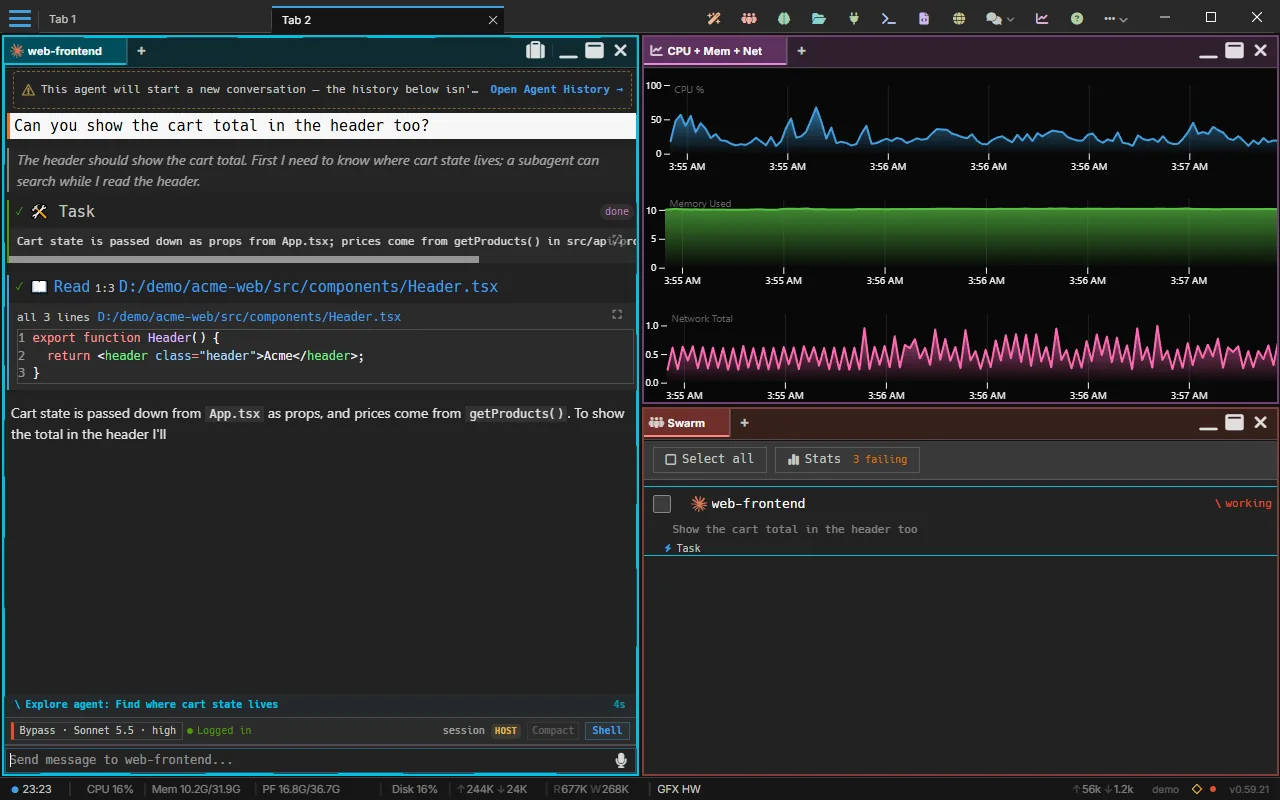
Modern agentic models spawn sub-agents to parallelize work. A single Claude Code session might fork five subagents for different subtasks. Without AgentMux's subagent watcher, you have no idea what those subagents are doing or when they go wrong.

  • +JSONL stream monitoring auto-detects spawned sub-agents and opens dedicated pane views
  • +Track multi-level agent hierarchies - parent agents, child agents, and their relationships
  • +See bootstrap output as each subagent receives its task and starts reasoning
  • +Without this visibility, a subagent can silently regress, corrupt data, or loop indefinitely
  • +No other tool provides real-time subagent observability - this is a gap that costs teams hours of debugging

Your tools are slower than your agents

Cursor and Windsurf regularly hit 3-40GB RAM in multi-day sessions. AgentMux runs on Chromium 146 (comparable download to Warp) but with a pure Rust backend — no GC pauses, no heap growth, flat memory from hour 1 to hour 8.

  • +Pure Rust backend: no Node.js, no V8 garbage collector, no pause-the-world freezes during agent operations
  • +150-350MB at idle, <1s startup — Cursor and Windsurf report 3-40GB RAM in prolonged sessions
  • +CEF (Chromium 146) — consistent rendering on Windows, macOS, and Linux, no WebView2 version mismatches
  • +Tokio async runtime handles thousands of concurrent WebSocket connections without thread overhead
  • +GPU-accelerated rendering with RDP-compatible fallback — smooth even on remote desktops
  • +Your CPU and RAM stay free for your agents, not your tooling

Agents regress silently

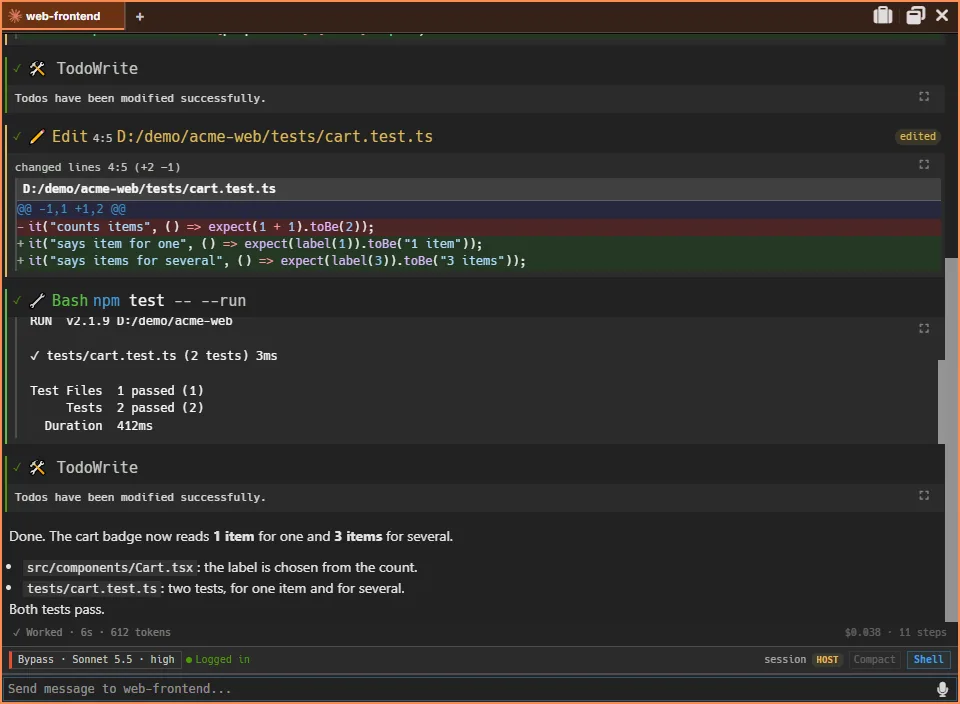
An agent fixes a bug, then undoes the fix three steps later. Without visibility into every decision step, you only discover the damage after it's merged. AgentMux streams every tool call as it happens.

  • +Stream-JSON parser renders agent output in real time - not after the fact
  • +Visual diff overlay shows file changes as they happen, not after the session ends
  • +Regression detection highlights when an agent reverts previously correct work
  • +One-click interrupt lets you redirect an agent mid-task before damage compounds
  • +Full session history with search - find exactly when and why an agent went off track
  • +Document model captures hierarchical message blocks - diffs, terminal output, code blocks - for replay

Multi-provider agents need a single pane of glass

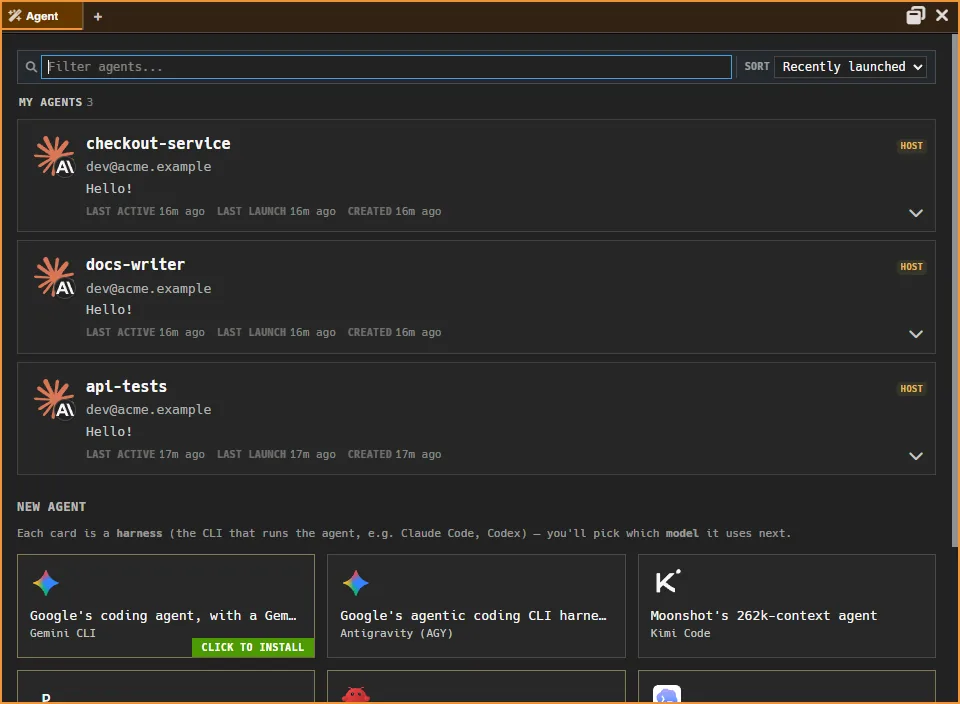
Your team uses Claude for reasoning, Codex for code generation, Gemini for data analysis. Today those are three separate terminals with three different output formats. AgentMux's Forge widget gives you one orchestration layer for all of them.

  • +Forge agent picker with SQLite-backed database - create, configure, and launch any provider
  • +Agent CLI installer handles setup for supported providers directly from AgentMux
  • +Structured presentation layer normalizes output across providers into a consistent UI
  • +Per-agent color coding, emoji icons, and status indicators for instant visual identification
  • +Real-time sync via WPS events - Forge changes propagate to all agent pickers instantly
  • +One-click agent spawning from the picker into any pane position in your layout

Agents need to talk to each other

Running multiple agents in isolation creates duplicated work, merge conflicts, and cascading errors. AgentMux's interpane reactive communication and agent auto-registration change that.

  • +Interpane channels let one agent's output stream directly into another agent's context
  • +Event-driven pane communication via Tokio channels - no polling, no shared files, no hacks
  • +Agent auto-registration - panes auto-register on the backend with capability advertising
  • +Offline message queue buffers messages when agents are offline, delivers on reconnect
  • +Visual connection indicators show which panes are linked and what data is flowing
  • +Reduces merge conflicts by giving agents awareness of each other's work in real time

Agents should control their own UI

Today's tools treat agents as dumb text streams. AgentMux's Agent App API lets agents create panes, render custom views, modify the workspace layout, and expose audit endpoints - all through a typed IPC bridge.

  • +Agents call the API to spawn new panes - terminals, editors, webviews, dashboards
  • +Self-modify their pane: update title, status indicators, layout position, color coding
  • +Create rich visualizations - progress bars, dependency graphs, deployment status
  • +Reactive injection endpoints for cross-host agent coordination with rate limiting
  • +Audit endpoint logs all agent injections for compliance, debugging, and governance
  • +The API bridges directly to the Rust backend via IPC - sub-millisecond response

Governance is no longer optional

The EU AI Act mandates human oversight of high-risk AI systems. The Colorado AI Act takes effect June 2026. 80% of companies with AI agents report boundary violations. You need audit trails, not just guardrails.

  • +Every tool call, file write, and data access captured with full context and identity
  • +Chain of Thought logging tracks decision rationale at every agent handoff point
  • +Session-level exports for regulatory evidence, post-incident review, and legal protection
  • +Runs locally with zero telemetry - audit data never leaves your infrastructure
  • +53% of organizations confirm daily agent access to sensitive data - visibility is non-negotiable
  • +NIST AI Agent Standards Initiative and ISO/IEC 42001 require runtime monitoring - AgentMux provides it

AgentMux builds AgentMux

AgentMux was rapidly developed by AI agents running inside AgentMux itself. Multiple agents working in parallel on frontend, backend, and infrastructure - coordinated through the same features that ship to you.

  • +Multiple agents work in parallel on different parts of the codebase - frontend, backend, infrastructure
  • +Subagent watcher tracked agent hierarchies during AgentMux's own development
  • +Regression detection caught real bugs during development - before they shipped
  • +The Agent App API was designed based on what our own agents needed while building the product
  • +Forge orchestration manages the agent fleet that builds AgentMux daily
  • +Dogfooding at its most literal - the tool exists because agents can build with it

Try AgentMux

Free and open source. ~152MB portable — no install needed.

Early alpha. Features may be incomplete or unstable. AI agents generate content that may be inaccurate — always review outputs. Report issues